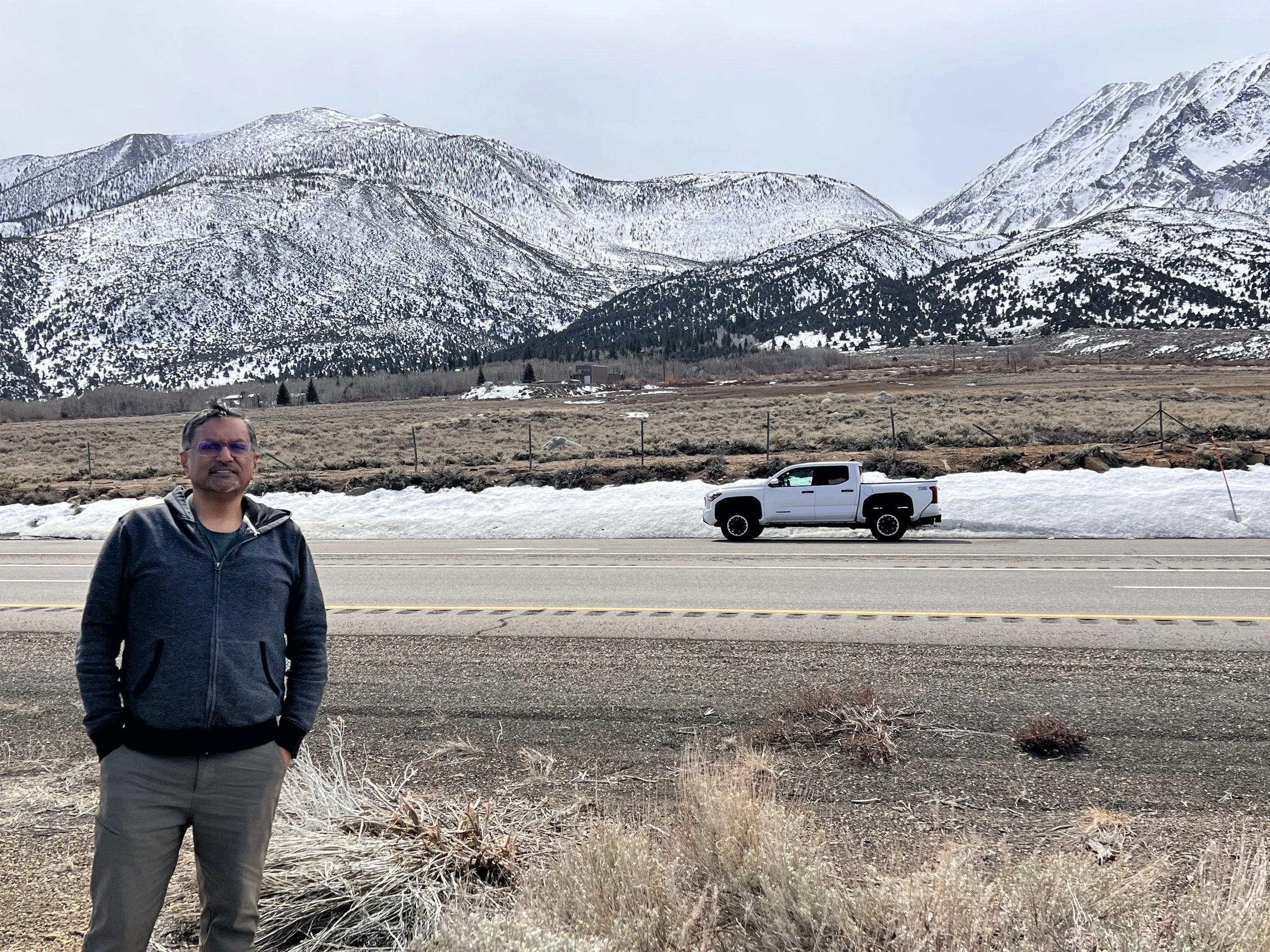
A quick used-car screening process to help decide whether a vehicle deserves the next investment of your time and money.
A pre-purchase inspection (PPI) is one of the most important steps when buying a used car. But before you spend the money on one, there are some simple checks you can do yourself.
None of these is a guarantee that a car is healthy. And passing every one of them does not eliminate the need for a PPI. Think of these as screening tests.
If a car fails badly enough on one or more of these basic checks, you may decide it isn't worth spending several hundred dollars to investigate further. If it passes, you may have a better candidate for a professional inspection.
Most of these checks apply equally to cars with manual transmissions. For a manual, simply skip the automatic-transmission-fluid section and substitute your own observations of clutch engagement, clutch slip, gear engagement and abnormal transmission noises during the test drive.
Before You Go
Hopefully, you have already followed our used-car buying process, researched the model, and checked the vehicle's available history before arriving at the dealer or seller for a test drive. Have the following on you:
A pair of disposable gloves
A few sheets of white paper towel
Before you arrive, ask the seller not to start the car. You want to see and hear it start completely cold.
1. Start With a Cold Engine
Before starting the car, confirm that the engine has not obviously been warmed up before you arrived. Then open the hood, get into the car, leave the driver's door open, and start the engine.
Listen carefully during the first few seconds. You're listening for anything unusual: persistent knocking, heavy tapping, grinding, squealing, rattling that may quickly disappear, or an abnormally rough start.
Some engines naturally make more mechanical noise than others, and a brief sound at startup isn't automatically evidence of a serious problem. The point is to identify something that deserves further investigation.
Let the engine idle for a few minutes. Watch the tachometer. After the initial cold-start fast idle settles, the engine should generally maintain a reasonably stable idle. Watch for surging, stumbling, excessive vibration, warning lights or an engine that seems to struggle to remain running.
If something doesn't seem right, make a note of it. It doesn't necessarily mean you should walk away, but it becomes something your PPI mechanic should specifically investigate. Then shut the engine off. Now grab those gloves and paper towel sheets in case you need them for the next steps.
2. Look Under the Oil Filler Cap
Put on your gloves and remove the engine-oil filler cap.
Some oil staining and varnish can be perfectly normal, especially on an older or higher-mileage engine. What you don't want to see is heavy sludge, thick baked-on deposits or a large accumulation of crusty material. Those conditions can suggest extended oil-change intervals, poor maintenance, excessive heat or other problems.
One important distinction: don't reject a car simply because the oil itself looks dark. Used engine oil normally darkens in service. What is considerably more concerning is oil that appears milky, creamy, foamy, unusually gritty or visibly contaminated with metallic particles.
Milky residue can indicate water or coolant contamination, although small amounts of condensation can sometimes accumulate under an oil cap on vehicles repeatedly driven on short trips. Heavy sludge or obvious contamination is different. At minimum, it warrants serious investigation before proceeding.
3. Check the Engine-Oil Dipstick
Pull the engine-oil dipstick, wipe it clean with your paper towel, reinstall it fully, then remove it again.
First check the oil level against the manufacturer's markings. An engine significantly below the proper oil level deserves attention. It may simply have been neglected between oil changes—or it may be consuming or leaking oil.
Again, don't focus too heavily on color. Brown or dark oil can be completely normal. Instead, look for milky or creamy contamination, visible metallic particles, grit or sludge, an obviously abnormal consistency, or a strong fuel smell. Any of these deserves further investigation.
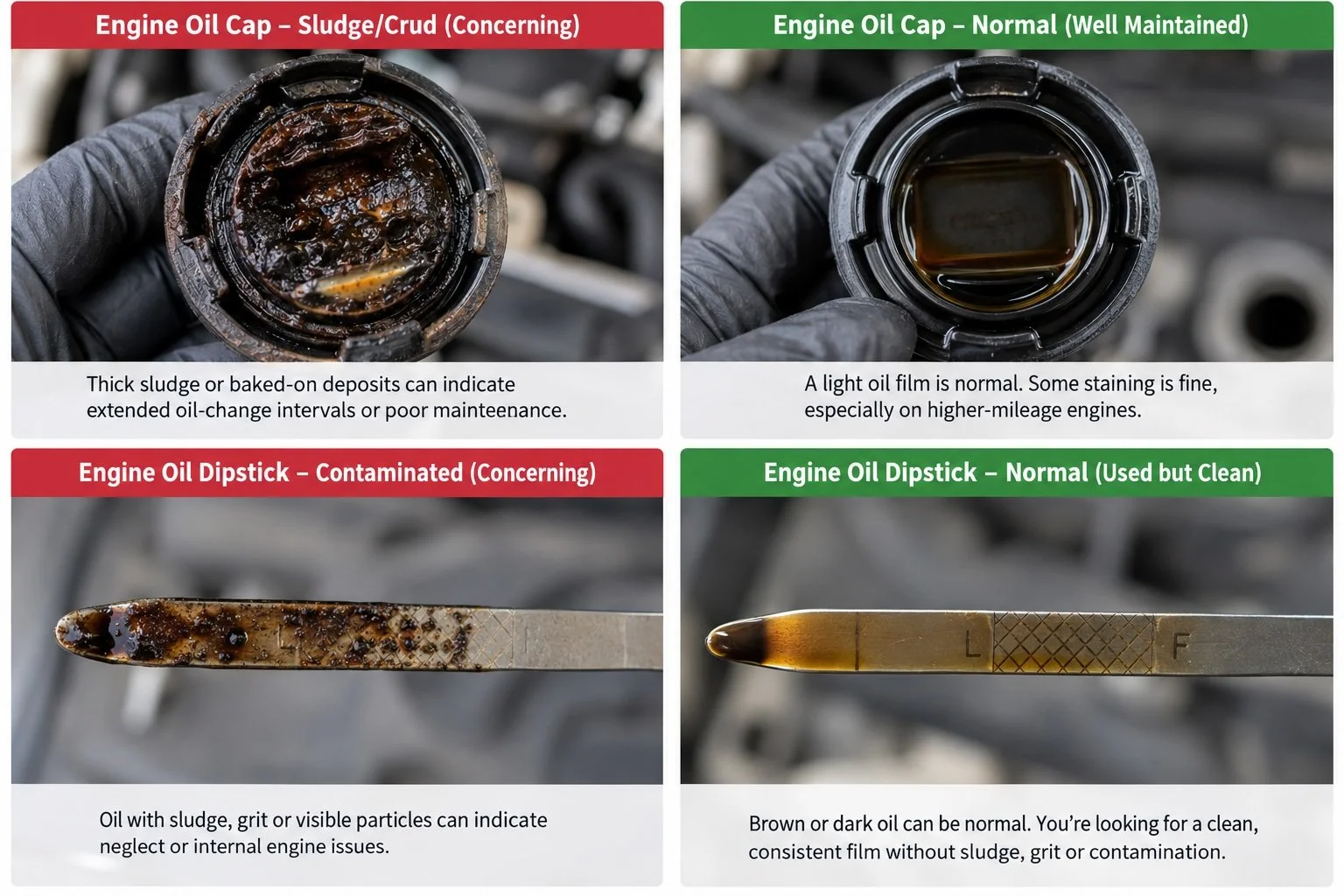
Oil-cap and dipstick examples: concerning conditions versus normal used-oil appearance.
4. Check the Automatic Transmission Fluid—If You Can
This check comes with an important caveat. Many modern cars no longer have an owner-accessible automatic-transmission dipstick. And on vehicles that do, the correct checking procedure varies substantially by manufacturer.
Some transmissions must be checked hot. Others have cold and hot ranges. Some require the engine to be running and the transmission in Park or Neutral. Others use entirely different procedures. Do not assume the engine-oil dipstick procedure applies to the transmission.
If the car has a transmission dipstick, consult the owner's manual for the correct procedure. If you're able to check it properly, look at both the level and condition of the fluid. A seriously incorrect fluid level can be a concern. Too little fluid can cause lubrication and hydraulic-pressure problems. Too much can also cause problems in some transmissions, including aeration or foaming.
Also smell the fluid. A pronounced burnt odor, especially when accompanied by very dark fluid, debris, abnormal shifting or other symptoms, deserves significant further investigation. Don't condemn a transmission based on fluid color alone—but don't ignore suspicious fluid combined with poor transmission behavior either.
If the vehicle doesn't provide an accessible dipstick, leave this critical check to the PPI.
5. Check the Brake-Fluid Reservoir
Locate the brake-fluid reservoir. Before opening anything, look through the translucent reservoir if possible. The fluid level should normally be between the MIN and MAX marks.
Brake fluid is generally clear to amber when new, although appearance varies with fluid type and age. Dark or cloudy fluid can suggest age or contamination, but color alone cannot tell you whether brake fluid is good or bad. Brake fluid absorbs moisture over time, and its actual condition is better evaluated through service records or proper testing.
What you're really looking for during this quick check is another piece of the maintenance puzzle. Very old-looking fluid, a low reservoir and no evidence that the brake fluid has ever been serviced can collectively suggest that routine maintenance hasn't been a priority.
6. Check the Coolant—But Only When the Engine Is Cold
Never remove a radiator or pressurized coolant-reservoir cap from a hot engine.
Depending on the vehicle, inspect the coolant through the translucent expansion tank or, where appropriate and safe, remove the radiator cap while the engine is completely cold.
Look for the correct coolant level. Coolant comes in many colors, so don't assume that one particular color is correct. What you're looking for is obvious contamination: oily residue, sludge, unusual cloudiness or evidence that incompatible coolants may have been mixed.
Oil contamination in the coolant can indicate a serious problem such as an internal engine or oil-cooler failure and should be investigated. A substantially low coolant level is also concerning. It doesn't prove the engine has overheated, but coolant doesn't normally disappear without a reason.
7. Now Drive It
Close the hood, start the car and go for a proper test drive.
For a conventional automatic transmission, shifts should generally be smooth and predictable without excessive slipping, flaring between gears, hesitation or harsh engagement.
A CVT behaves differently from a conventional automatic and may hold engine RPM rather than producing distinct gear changes. What you're looking for instead is smooth, predictable acceleration without abnormal shuddering, hesitation, noises or delayed engagement.
Pay particular attention when shifting from Park into Reverse and Drive. A violent engagement or significant clunk deserves investigation. A small amount of driveline movement can be normal, especially on trucks, SUVs and vehicles with more complex drivetrains, so don't automatically diagnose a transmission problem from one noise. Simply put it on the PPI list.
8. Get It Up to Highway Speed
If possible, drive the car on the highway. On a reasonably flat road, the car should track predictably without requiring constant steering correction.
A pull or wandering sensation can have many causes—including tire pressure, tire wear, alignment, steering components or suspension wear—so don't try to diagnose the exact cause from the driver's seat. Just recognize that something may need attention.
Pay attention to how the car reacts to bumps and road imperfections. Does it settle quickly? Or does it continue bouncing, feel unstable or seem to float down the road? Those sensations can point toward worn shocks, struts, bushings or other suspension components.
Also pay attention to steering-wheel vibration, driveline vibration and unusual noises that appear only at particular speeds.
9. Test the Brakes
When traffic conditions make it safe, perform several controlled braking tests. The car should stop predictably and in a straight line.
Look for steering-wheel vibration, brake-pedal pulsation, shuddering, pulling strongly to one side, grinding or unusual noises, or an excessively soft or spongy pedal. Any of these should go onto the PPI inspection list.
10. Find an Empty Parking Lot
At very low speed, make tight left and right turns. Listen for repeated clicking, clunking, grinding or binding.
Clicking during tight turns can sometimes indicate CV-joint wear on vehicles equipped with CV axles, while clunks or other noises can come from steering, suspension or driveline components.
Again, you're not trying to diagnose the car in the parking lot. You're identifying symptoms.
11. Try a Simple Suspension Check
Park the car and shut it off. At each corner, push down firmly on the body and release it. The suspension should generally rise and settle quickly. If the car continues oscillating several times, the shocks or struts may be worn.
This old-fashioned “bounce test” isn't definitive—modern suspension systems can make it less useful than it once was—but obvious continued bouncing is still worth noting.
Also look at the car from several feet away. Does one corner appear lower than another? Does the vehicle sit level? Uneven ride height can point toward spring, suspension or load-related issues that deserve investigation.
12. Walk Around the Car One More Time
Now perform your basic body inspection. Look at panel gaps, paint-color differences, overspray, misaligned doors, hood or trunk, uneven tire wear, cracked or mismatched lights, signs of corrosion and evidence of previous body repair.
Use our separate guide for evaluating body panels, paint and previous collision repairs for a more detailed walkthrough.
So, Did the Car Pass?
That's really the point of this exercise.
You haven't determined that the car is “good.” You haven't replaced a professional inspection. And you certainly haven't proved that nothing expensive is about to break.
What you've done is something much simpler: you've decided whether this particular used car deserves the next investment of your time and money.
If you found heavy engine sludge, contaminated fluids, serious drivetrain noises, obvious overheating evidence, major suspension problems or poor driving behavior, you may already have enough information to move on to the next car.
If everything looks reasonable, the vehicle becomes a much better candidate for a professional pre-purchase inspection. When possible, we prefer a lift-based PPI by an independent mechanic who can inspect the underside of the vehicle, steering and suspension components, leaks, brakes, drivetrain and structural condition—not just what can be seen from a parking lot.
Passing these checks doesn't mean you should skip the PPI. It means the car may have earned one.
If you'd rather not do some or all of this yourself, that’s exactly what we're here for. ExactQuestgives you an independent, engineering-based read on a specific car’s condition or a specific market segment — current pricing, what's fair for the Boston market right now, and what to watch for regionally. We can also arrange Level 1 (on-site) and/or Level 2 (on lift) PPIs depending on service selected.
Schedule a free, no-obligation consultation and we'll walk through what makes sense for the car you are interested in. If you are not sure whether paid advice is worth it for you, run a total cost of ownership calculator and see if the investment in paid advice is worth it for you.
We don't sell cars, and we don't take commissions or referral fees from any seller. We only work for you, the buyer.
About the author: I’m a retired engineer, lifelong automotive enthusiast, and founder of ExactQuest. I bring an engineering mindset to used-car buying—digging into vehicle history, reliability, market value, and probable downstream ownership costs to help buyers make better-informed decisions from a total cost of ownership perspective.
© ExactQuest LLC 2026